
How to Build a Brand People Recognize Before They Even See Your Name (A Starter Guide)
We know the brands who just have a way about them. An aura, if you will. They exude confidence, have a brand visual strategy worth envying, and the kind of vibe that says, “take my credit card already!”
If I were a betting woman, I’d imagine the brand that you currently have in your head are product-based brands, right? Product-based brands don’t just sell products; in fact, I’d argue that the products themselves aren’t the main attraction (even if they do solve a problem for their ideal clients). Product-based businesses sell a lifestyle, the kind you’d be able to acquire if you bought their products.
Before we get into the finer details around building a brand so recognizable your people won’t have to see the name to know it’s yours, I wanted to make one point clear: you don’t have to want to build an empire like some of these larger brands to make branding for (well) for you.
While product-based brands benefit big time on having a recognizable brand presence, I’d also argue that creative service providers, like copywriters, web designers, and social media managers, who are the face of their brand (and/or want a front-facing role in their brand) have a lot to gain by borrowing a page out of the product-based brand playbook.
HOT TAKE: I actually think branding your service-based business is all the more important because there are so many people online nowadays trying to sell their expertise. Why?
Recognition = perspective + repetition
The creative service providers who are going to win—ugh, I just bristled at that word, so let’s try this again. The brands who become sought-out for their ideas/be everyone’s favourite referral (much better!) are the ones who lead with thoughtful perspectives and a whole lot of personality (heavy on the “personal”!).
(Side note: the interjection I made above about the word “win” is a perfect example of brand voice in practice. Er, more so when your brand voice feels out of alignment rather. I’ll be talking more about how to identify your brand voice below).
So without further rambling, here is a starter guide to help you build your brand’s visibility icon status.
Step 1: Recognize Your Offline Patterns
If you ever needed the permission to get offline and go crochet/knit/colour/dance/insert whatever activity you’d rather be doing, consider this your permission slip *hands you slip*.
I like to think of the habits & routines you do offline as brand cues, tiny moments in your everyday life that shape your brand. You can think of them like little breadcrumbs (brand crumbs lol?) guiding you back to your “why.”
These are the things you actually care about (read: value).
Practice Exercise:
Take 10-15 minutes to reflect on your daily habits & routines and answer these 4 prompts below.
In your day-to-day, what do you…
Make time for (i.e. voice-noting friends instead of texting, spending quality time with your dog, shutting your laptop off by 4 pm, giving back to your community, etc.)
Protect (i.e. slow mornings before checking your phone, keeping hobbies as hobbies, the freedom to change your mind mid-process, white space in your calendar, your energy after client calls, etc.)
Return to (i.e. old journals or notes for inspo, reorganize your space when things feels fuzzy, take breaks when things stop feeling fun without the guilt, old hobbies that made you happy, etc.)
Refuse to do (i.e. post just to “be consistent”, urgency-based selling, be “on” all the time, let the algo dictate your creative rhythm, agree to quick timelines that ignore your capacity, etc.)
They may not seem flashy, but these are the “cues” people will start to recognize your brand for because they are intuitively embedded in your life.
Your habits aren’t just habits. Your habits are headlines waiting to happen. Little jumping off points to build deeper connections with your people. Moments to remind your audience that yes, behind the brand is a person who just wants to build a life that supports the creative hobbies you want to spend all your time doing (just me?)
For my client, Brooke at Embody Creative Co. we peppered her personality into various places on her website (i.e. her Mini About headers, as eyebrow text, within her service names).
Brooke is a very crafty gal. A true serial hobbyist, you can probably find her knitting, reading, scrapbooking, or baking (or whatever new hobby she’s picked up between when we worked together and now). I love her for that and, since she works with highly creative, multi-passionate creative business owners, I knew her dream clients would, too. See below for an example plucked directly from the Embody Creative Co. website of how we brought Brooke’s personal brand cues into her web copy.
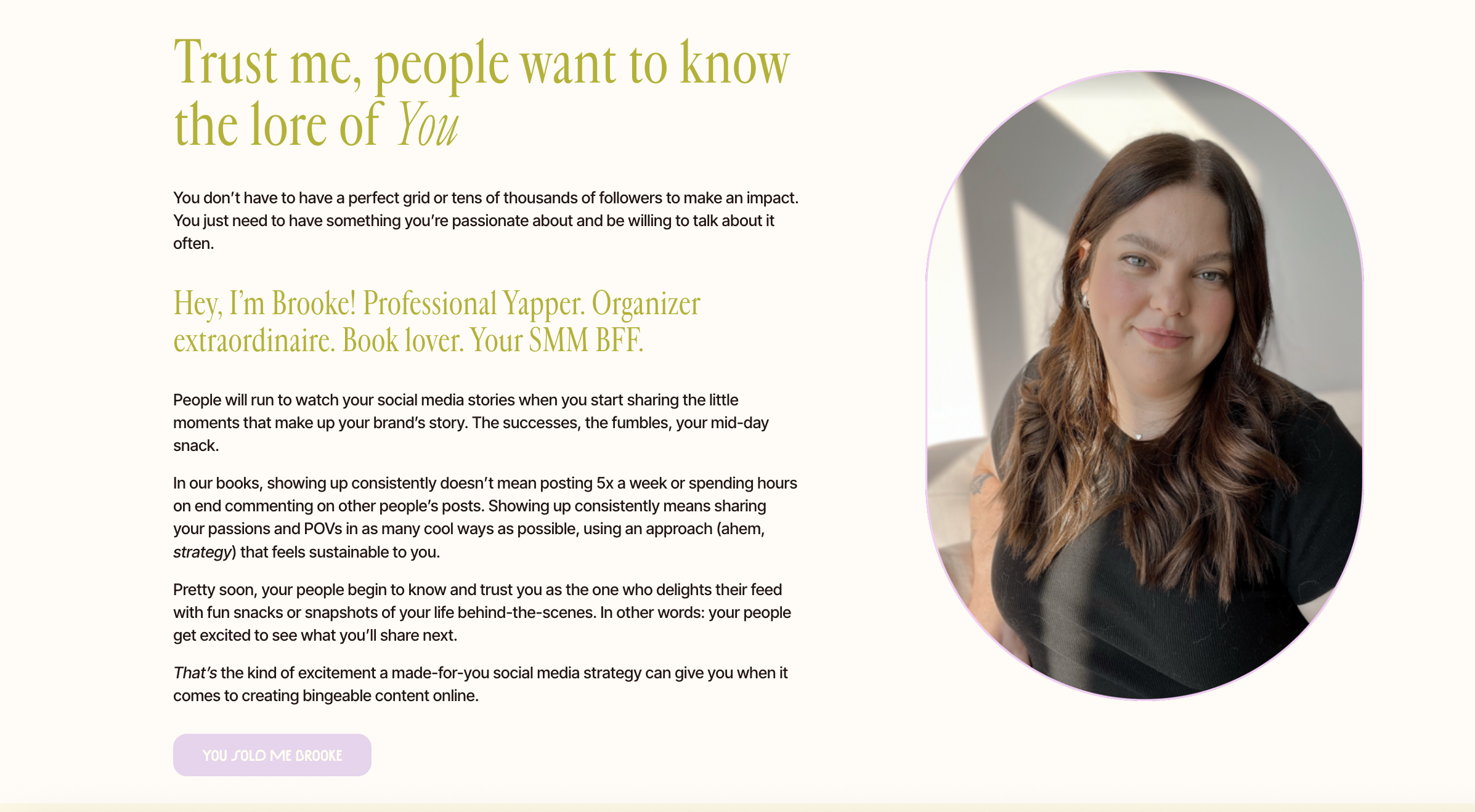
(Click here to see how we turned Brooke’s website into a haven for creative business owners who want a retreat from the hustle and grind of typical social media biz advice)
Step 2: Narrow Down Your Values
Your values aren’t just static buzzwords to display on your About Page (even thought sometimes they feel that way). Whether you share them or not, they’re behaviours that inform how you go about your day (a.k.a. like the things you do on repeat that you uncovered Step 1).
Let’s look at a few examples:
The value “Community” could look like inviting people into the process.
The value “Creativity” could look like experimentation over perfection.
The value “Integrity” could look like not doing something just because everyone else is doing it.
Now, “Community” or another other value won’t have the same actions or perspective for everyone, which is kind of the point. Your lived experiences will help you define what you value most and the perspective you want to share. For one person, “Community” could look like inviting people into the process, whereas for another person, it could look like building a sense of belonging.
Every single one of these values can have different brand cues attached to them, depending on different variables. Whatever value you resonate with most can make the difference between using the world “experiment” vs “invitation” vs. “rebellious.”
When you identify the behaviours you live by, you’re already putting in the hard work to figure out which words and tone make the most sense for your brand. (A.k.a. spend more time offline, please! It’s good for your branding!)
Take my girl, Brooke, again. Brooke loves a good night out with the girls to yap over drinks and apps. With this in mind, we wanted the tone and feel of her website to reflect, simultaneously, a girly group chat and the fun, freeing feeling of what happens when the Girl’s Night Out makes it out of the group chat. By creating copy that evokes this feeling of good chats over good food, we embodied (hehe, see what I did there) how feeling Brooke wants her people to feel about social media: like it’s (finally) a fun place to be.
That’s why we chose the below values for Embody Creative Co. because they embodied who Brooke is as a social media manager and strategist.
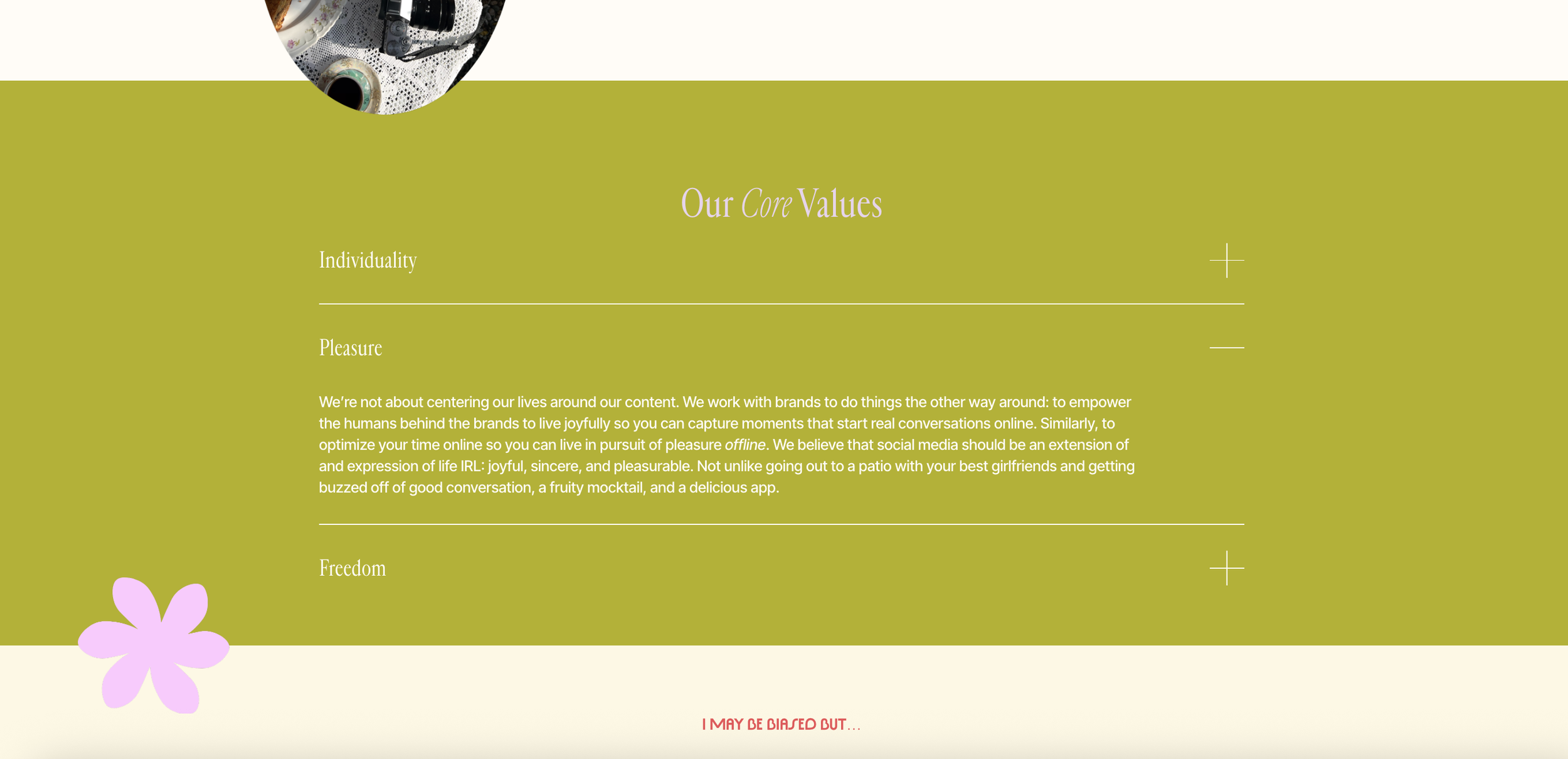
(browse the Embody Creative Co’s full case study here)
Which brings us to…
Step 3: Define Your Leading Conversations
Your POV is often hidden in how you explain things to friends or clients. You know when get a lightbulb moment the minute you start talking to someone about an idea you have but need a sounding board? If your copy feels off, it might be because it doesn’t match how you actually like to connect.
In other words, the convos you want to lead online mirror the convos you crave offline (or in DMs).
Bonus points if you bring your hobbies and niche interests (let’s be honest, we both know you have them) into your POV to create new and unexpected intersections, that’s where the real magic happens.
For example:
Maybe you’re an academic-turned-brand-designer and you live for reading niche JSTOR papers on a Friday night. Not only would you be the kind of person I’d want to party with, but maybe one of the conversations you want to lead, or the POVs you have, is all about how brand identities should be intentionally nuanced.
Or maybe you’re a social media strategist who spends your downtime at the fabric store because you’ve been wanting to take up sewing (same!). Perhaps you want to inspire others with the POV that social media should be experimental and, to practice what you preach, you take them on your journey of learning to sew.
Practice Exercise:
Pick 1–2 conversations you’d love to talk about—and often
Choose a repeatable format to yap to your heart’s content about these topics (column, series, ritual, framework)
Tone Check
Here’s a self-reflection prompt that will (hopefully) be a little more helpful than the advice, “just write like you talk” without what that could look like in written words.
Do you love deep, meandering conversations over coffee? Are you the kind of person who hates small talk, but could have deep conversations with strangers at a party? Chances are, you’re probably going to dislike writing punchy, super-tight copy. (From one long-winded creative to another, I like to call this, “enjoying the scenic route” 😏)
Do you speak in memes and if you had to use your phone send 5-min voice notes to your besties instead of text messages? Your brand likely craves dialogue in a casual tone. When you’re writing copy, ask your reader self-reflective questions and don’t be afraid to bring your voice into your copy using italics.
Do you have a sharp tongue and always have the best one-liners? Leverage this natural talent (must be nice!! 😉) in your copy.
BTW, If you’re struggling to figure out how to write copy that sounds like you, I created a free resource for you, Brand Archetype Quiz, to support. Take this Y2K-inspired quiz to find main brand archetype and gain instant access to a treasure trove of copywriting strategies, with copy prompts you can swipe right from the doc, so you can (finally) stop second-guessing your copy (read: no more 49493 drafts) and start getting noticed.
The TL;DR?
The habits, tone, POV, phrasing, & content formats your share on repeat not only work together to anchor your brand (so showing up feels like a piece of cake) but become the very thing people know you for.
And if you’d love support building your service-based business into an iconic brand people would wait in line to work with (nose pressed to the glass for a little peek at what’s to come), you’re going to LOVE Brand Mag, the custom brand messaging resource so good you don’t wanna put it down.

If there’s one thing I could tell my younger self, it’s this:
Write now (right now) , edit later.
Even as a copywriter, it took me a long time to really show up and share my voice in the way that I had wanted to. I was always scared of the vulnerability hangover that usually comes after speaking, as a deeply sensitive, (over)thinking human.
And I’ve almost let the self-doubt win a handful of times. Almost.
But I keep coming back to the advice I would give myself when building something I was proud of was still just a dream reserved for my notebooks.
Starting is the first step. And the second. And the third. Because once you start, you usually tend to see that the rest isn’t so bad, and then the next thing you know you have a business that supports the life you’re building and you’re actually having a heck of a lot of fun.
Whoops, I guess I should probably introduce myself, huh? I’m Taylor, a copywriter and brand messaging stylist teaching creative service pros worldwide how to wield brand messaging and copywriting to build the business (and life) they want.
Whether you’re DIYing your copy or you’re ready to collaborate with someone who will 1000% be entirely (too?) invested in your project, I’m so glad you’re here.
