
How to Write Copy That Feels Like a Conversation
I’m going to guess you know what it’s like to see copy in the wild that feels like a slimy ad campaign from the Mad Men Era or like a pitch a particularly short, balding used car salesman character (IYKYK *ahem millennials should know*). And I’m also going to guess you don’t want to be sound like either of those things (hence why you’re here right now).
Over the last several years we’ve seen the fall of the girlboss, the rejection of traditional coaching and terms like “guru” and “mastermind” (a personal ick of mine), and the return to a more honest way of being in business. One that doesn’t feel so… desperate? icky? elevator pitchy? I feel like we’ve entered the creative biz renaissance, a soft biz uprising, if you will. I think a lot of creatives, including myself, are challenging the status quo of the consumer culture we’re all apart of and, as good people who want to make the world a better place, would rather not burn ourselves out or sell ourselves out just to make that a reality (call me crazy…).
For one, how we buy things has changed. It’s not enough for someone to tell us their mastermind is going to “make them 10k months” or that they’ll be able to “work 2 hours a week from a remote beach in Bali.” Dreams have been bigger than ever, but how creative service pros get there has landed closer to home—literally. The way people gain your trust now as a creative business owner is by giving them a peek into your world. They’re less interested in perfection and more interested in the process, especially when it’s still kind of half-baked. They make buying decisions as much on vibe as on deliverables, and they (usually) reject grandiose income claims in favour of language that feels like you’re just two people talking over coffee. The latter of which is conversational copy.
But First, What is Conversational Copy Exactly?
Sometimes talking about what something isn’t is just as important as talking about what something is. So let’s start there, yeah?
Conversational copy does NOT pour salt in wounds (instead, it empathizes with what your dream client is going through to show you understand them)
Conversational copy does NOT use (false) urgency tactics just to sell (instead, it is honest and human)
Conversational copy is NOT designed to harm, in any way shape or form (instead, it gives your dream client everything they need to know to make an educated decision that’s best for them, not your bottom line)
Comparatively, conversational copy is copy that sounds and feels conversational in tone. It’s turns of phrases you’d say at the coffee shop or in a group chat, words of affirmation you’d give your most precious bestie, and it leads with personality over persuasion. Spoiler alert: conversational copy is inherently persuasive because of that one really big, important thing we’ve hinted at already about: trust.
In a word (or a few), it’s being able to “write how you talk.” But you and I both know that’s not always the most helpful advice when you’re 17 drafts deep in your homepage header.
So, how do “write like you talk”?
Copy that sounds conversational, like how you’d talk IRL, is copy that employs different techniques to make your reader able to hear your voice in their head. This is honestly one of my favourite ways to spice up bland copy because it (quite often literally) shifts the tone of the copy.
But before we do any of this…
Consider this your full permission to write a really bad absolutely no good first draft first. I’m serious. Writing conversational copy feels like a bit of a misnomer because, arguably, the most conversational copy is edited to sound that way. Unless you have writing superpowers and can write perfectly right off the bat (in which case, help a sister out), if your writing sounds stiff or boring to begin with, you’re right where you should be. This is a perfect canvas to a really juicy final draft.
So embrace the bad first draft with open arms, k?
Sweet! Now let’s get into my top 5 favourite ways to make your copy sound more like a chat with friends below.
1. Ask questions
Asking questions is one technique you can use to make your copy feel and sound more conversational because you’re naturally creating space for “dialogue,” even on a one-dimensional page. Why do we ask questions in the first place? It’s usually because we either don’t understand something and want to or because we do understand something and want to confirm our understanding. Either way, when you ask questions in your copy, you’re mirroring back to someone that you’re engaging with them, not just talking at them. That’s what makes asking questions so impactful in your copy. Here are two quick ways you can add questions to your copy to make it read more ~cazhhh~:
To empathize with the situation they’re experiencing so that you show them you understand what they’re going through. These questions also act as self-identifying moments for your readers to metaphorically raise their hand and say, “this space/offer/person is for me.”
To give your reader something to reflect on, which could act as a the emoji equivalent of 👀 or a mic-drop moment, as I like to call it. The purpose behind this kind of question is to give them something to think about as you lead them into the next section of your sales page or website. Here is an example of leveraging reflection questions for About Monday’s Scoops Sales Page. We wanted to redefine what “more” could mean for people ready to leverage social media for their business. Instead of leaning into this expectation of having to “do more,” we wanted to introduce the idea that all of these terms we often negatively associate with social media could actually be framed in a positive, generative way. This philosophy is what grounds Melo’s Scoops offer and acts as a perfect introduction to Scoops; if her reader gels with these reframes, they’re going to love what Scoops is all about.
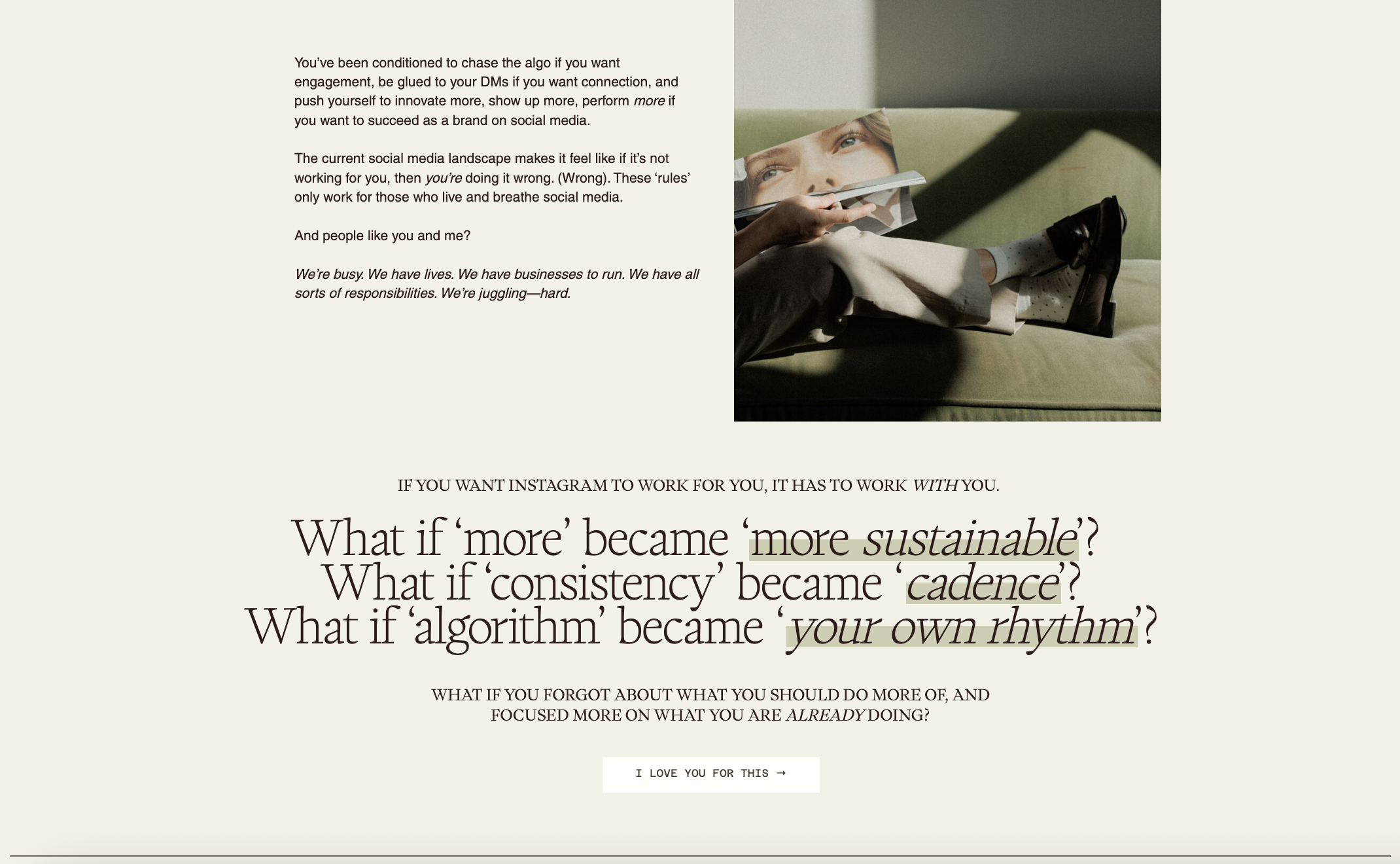
(You can see the rest of the work I did for About Mondays here)
2. Break Grammar Rules (Where Applicable)
You’ve probably already recognized this with my own writing but I love a good grammar rule break. It feels so freeing. Because despite what your 3rd grade teacher probably taught you, you can start a sentence with “And” or “But” or “Because.”
Because when you do this, it actually makes your copy sound more conversational and fun to read. I don’t make the rules (but I do break them, hehe)! The more you make your copy read like you’re in the middle of a convo, the more engaging your copy actually feels.
Oh, and while you’re at it, go ahead and make your sentences shorter, too. Kind of like fragments. Those usually roll off the tongue more so than longer sentences anyways.
See what I did there? 😉
3. Use Active Voice
Remember what I said about your 3rd grade teacher not being right? This is actually where their advice still rings true. I’ve read a lot of websites and sales pages over the years and I’d say about half the time they’re written in a passive voice. And a lot of the time, I think it’s by accident. One of the reasons I think so many people unintentionally write in passive voice is because they’re not really sure what they’re trying to say, or they don’t feel confident in what they’re saying. This is usually a pretty easy fix you can do if your copy sounds like it’s beating around the bush instead of clear (clear = compelling).
Let’s look at a quick example:
Passive voice: I help purpose-driven business owners get their time back by customizing their backend systems to work harder for them.
See how this example is super windy? We can do a lot more with less words and focus on the parts of the statement that really matter. Kind of like this:
Active voice: I build backend systems for business owners with better things to do
Most of the time, going from passive to active voice is merely a matter of doing an ole switch-a-roo between the subject and the action so that the action comes first.
4. Use italics or brackets for expressing inner thoughts
Okay, this might be my favourite way to make my or my client’s copy more conversational (but don’t tell the others). And it’s to leverage italics or parentheses within my copy so as to emulate an inner dialogue moment. It’s kind of like the 💭 emoji in words.
Leveraging italics or parentheses function as narrative disruptors that feel casual in tone. You’ll see this a lot in literature, but the same principles work really well for copy, too.
Here’s how I might use each on a sales page:
If you’ve ever jolted awake in the middle of the night with the thought, omg, did I ever reply to that client inquiry? 😳 (you didn’t) or spent wasted hours combing through one of five notebooks because you swore you wrote down a killller one-liner … somewhere …
It's not because you don't care or because you're lazy (you're not). Chances are, you’re actually just trying to run an entire business without a system (and no, your notes app isn’t a system).
This one can be a little harder to finesse in your copy, but try to emulate natural moments where you might use these kinds of narrative pattern disrupters IRL to guide how you deploy them in your copy.
5. Embody your brand archetype online
Part of what makes good copy conversational is that it sounds like you IRL. We’ve been over this, but I really want to hit that point home. 😉
When clients first reach out to me, 9/10 times one of the biggest reasons they inquire is because the copy they write doesn’t sound like them.
So I asked myself, “how can I help creatives write copy that sounds like them in a way that feels more fun and helpful than just ‘write like you talk’?”
Enter: the Brand Archetype Quiz
A.k.a. the Y2K-inspired quiz that reveals your primary brand archetype and gives you copywriting strategies to try, plus oodles of swipe copy that matches the tone and energy of each archetype.
When you write in a way that matches your voice and your energy—slightly different depending on whether you’re poetic or direct or colloquial—you’ll naturally start to write with a more conversational flair.
The TL;DR?
I’ll be the first to admit that writing copy is hard. But it’s a practice that becomes more natural the more you do it. And when you have techniques in your copywriting toolkit like the five above, the process becomes even less intimidating and, dare I say, maybe something you’ll actually enjoy?
A girl can dream, right?

If there’s one thing I could tell my younger self, it’s this:
Write now (right now) , edit later.
Even as a copywriter, it took me a long time to really show up and share my voice in the way that I had wanted to. I was always scared of the vulnerability hangover that usually comes after speaking, as a deeply sensitive, (over)thinking human.
And I’ve almost let the self-doubt win a handful of times. Almost.
But I keep coming back to the advice I would give myself when building something I was proud of was still just a dream reserved for my notebooks.
Starting is the first step. And the second. And the third. Because once you start, you usually tend to see that the rest isn’t so bad, and then the next thing you know you have a business that supports the life you’re building and you’re actually having a heck of a lot of fun.
Whoops, I guess I should probably introduce myself, huh? I’m Taylor, a copywriter and brand messaging stylist teaching creative service pros worldwide how to wield brand messaging and copywriting to build the business (and life) they want.
Whether you’re DIYing your copy or you’re ready to collaborate with someone who will 1000% be entirely (too?) invested in your project, I’m so glad you’re here.
