
How to Structure Your Sales Page For Better Conversions
Not to be dramatic, but your sales page might be the most important page on your website, besides maybe your homepage. Your sales page is specifically all about your offer and it has a really important job to do: to act as your offer’s hardest working sales person.
Let’s get this out of the way first: your services, at least your signature ones, need a sales page. Service pages aren’t bad—they’re a great overview of your services. But if you’re really focused on boosting your conversations around a specific offer, a services page won’t do your offer justice like a sales page can.
Ok, now that I’ve entirely convinced you that a sales page is a non-negosh if you want to boost conversions for your offer (right?), let’s get into how you can do that.
So what’s so special about a sales page anyway?
Your sales page isn’t just about slapping a description of your offer and its deliverables on the page and calling it a day. Your sales page is art. Kidding... sorta.
At least it is for me and I’m going to try my darndest to make you see it that way, too.
If you couldn’t tell, I’m a big fan of sales pages. I love reading them. I love writing them. Dare I even say, I love studying them to understand why certain sales pages work (and why others flop). Yes, I’m a nerd. But this nerd is going to help you write a sales page worth saying, “take my credit card, pleeaaase!”
Writing a conversion-worthy sales page is an art form. It takes emotional storytelling, linguistic agility, and creative presentation skills to really turn browsers into buyers.
(Yes, I have in fact been watching too much ice dancing at this year’s Olympics, but you get the idea…)
To do your offer justice, your sales page should take your reader on a journey so that by the end of the sales page, they know, with ten toes down, that your offer is for them.
Below, I’ll introduce the arc of a sales page and walk you through each of the 4 umbrella sections you need for a stronger sales page. And because I want you to go off and write your sales page with next-level confidence after reading this blog post, I’m also handing you all the questions you need to answer before you even start writing. I answer these questions every single time I write a sale page for a new offer.
Before we go any further: there are many ways to structure a sales page and it can depend on several factors, like what you're selling, who you're selling to, and what their motivations are. That's why I'm sharing a simple structure with all the sections you (usually) need to include so you can go off and zhuzh to your heart's content. The offer you’re creating—whether it’s a group program, digital product, or membership—will ultimately dictate what sections you need to include, where, and how. But this is a good place to start if you’re writing your first sales page or you’ve written sales pages before but they’ve not been doing their job to convert new leads.
Ok enough of my babbling! Let's get into it!
Above-the-Fold
There’s a reason I usually write the above-the-fold section, or H1 header, last (unless I’ve had a lightbulb moment where I’ve come up with the most genius copy without needing to revise it at all but that rarely happens) and it’s because there’s a lot riding on this section.
Think of the above-the-fold as the section that determines whether your reader is going to stick around or not. In other words, she’s kind of a big deal (no pressure, right? 😅).
The ultimate goal of this section is to entice prospective clients to keep reading. You don’t want to just introduce your offer here because, chances are, they’re actually not ready to hear about your offer. You need to meet them where they are and usually, at the top of the page, that’s more in the Problem Unaware or Problem Aware stage (dw, I wrote all about the stages of awareness if you need a refresher).
Below are 3 ways you can write your above-the-fold to make sure your people stay on the page, plus an explanation on why each works.
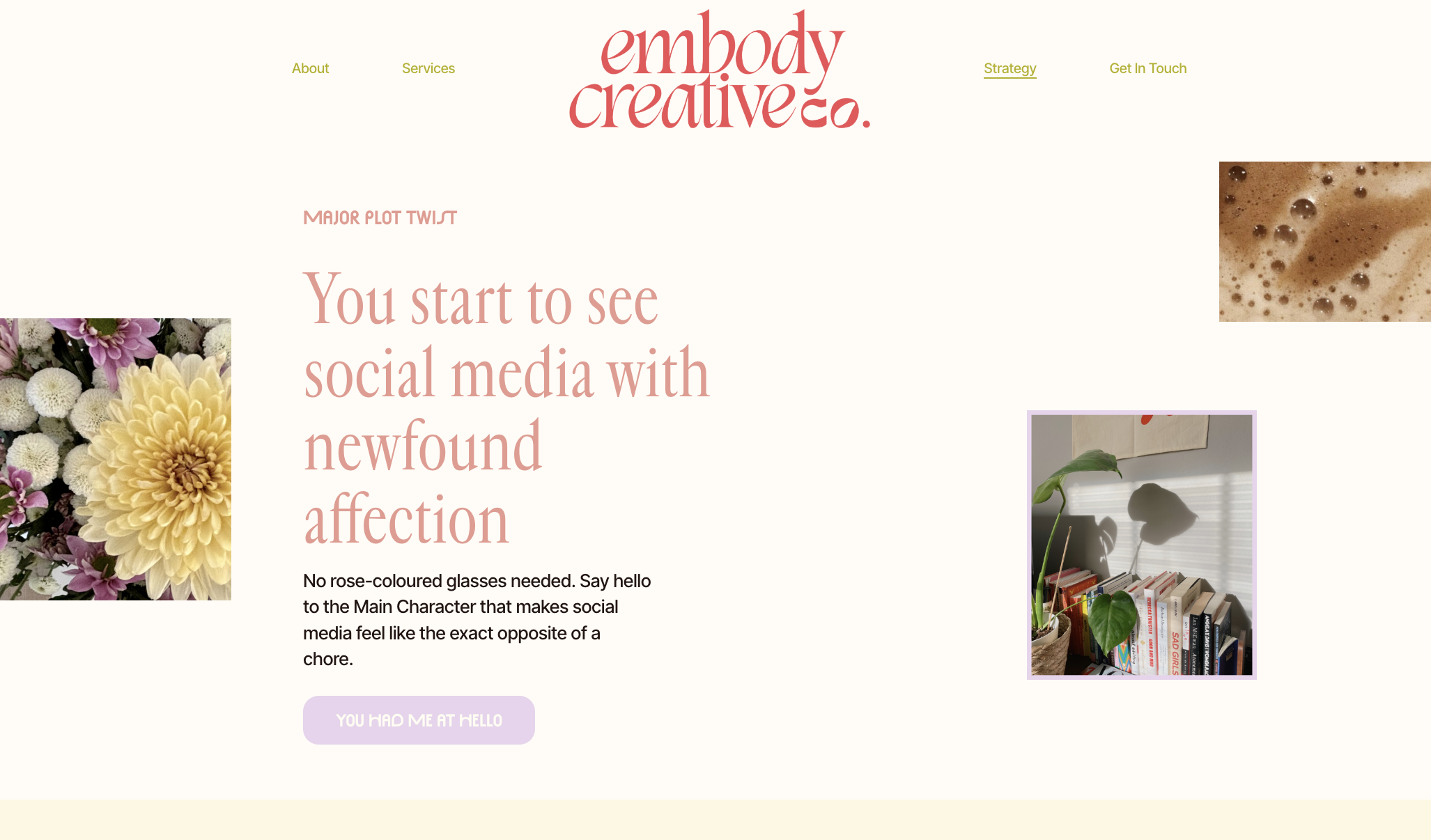
Transformation Header: Give them a taste of how they're going to feel after they work with you.
Here’s the H1 header copy I created for Embody Creative Co. You can view the full case study here.
Why this works: Think of this kind of header as a double-take moment; your prospective client sees that maybe there’s a better solution out there they didn’t even know was possible for them—and they want it. The sales psych behind it is: you’ve piqued their curiosity so they now need to know how you’ll help them get to the other side.
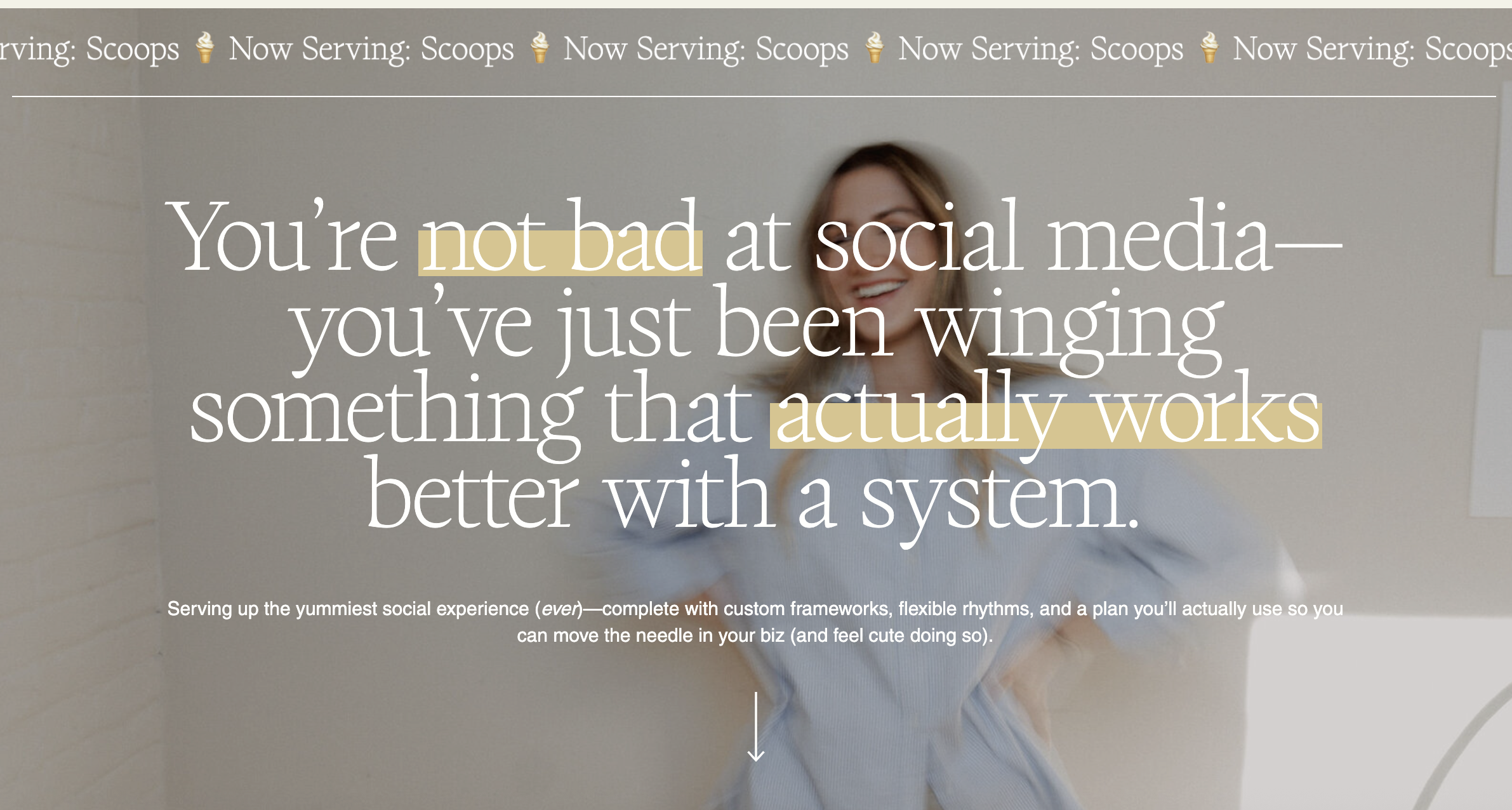
Shake Up Header - Shake up their pre-conceived notions with a statement they won't be able to forget.
This H1 header for About Mondays is like a sigh of relief in a sentence. View the full case study here.
Why this works: This H1 header for About Mondays is like a sigh of relief in a sentence. The impact of a sentence that reveals to you it’s not your fault can never be underestimated. This kind of header works because you’re debunking a major block they’ve been having that’s stopping them from seeing the potential of a solution, let alone an actual solution. In About Monday’s case, we’re moving the reader from Problem Unaware to Problem Aware so that they can stop seeing themselves as the problem and start recognizing that they just don’t have the system to make it work for them. Emotionally we’re moving them from “This is just the way things are” to “I’m capable of fixing this.”
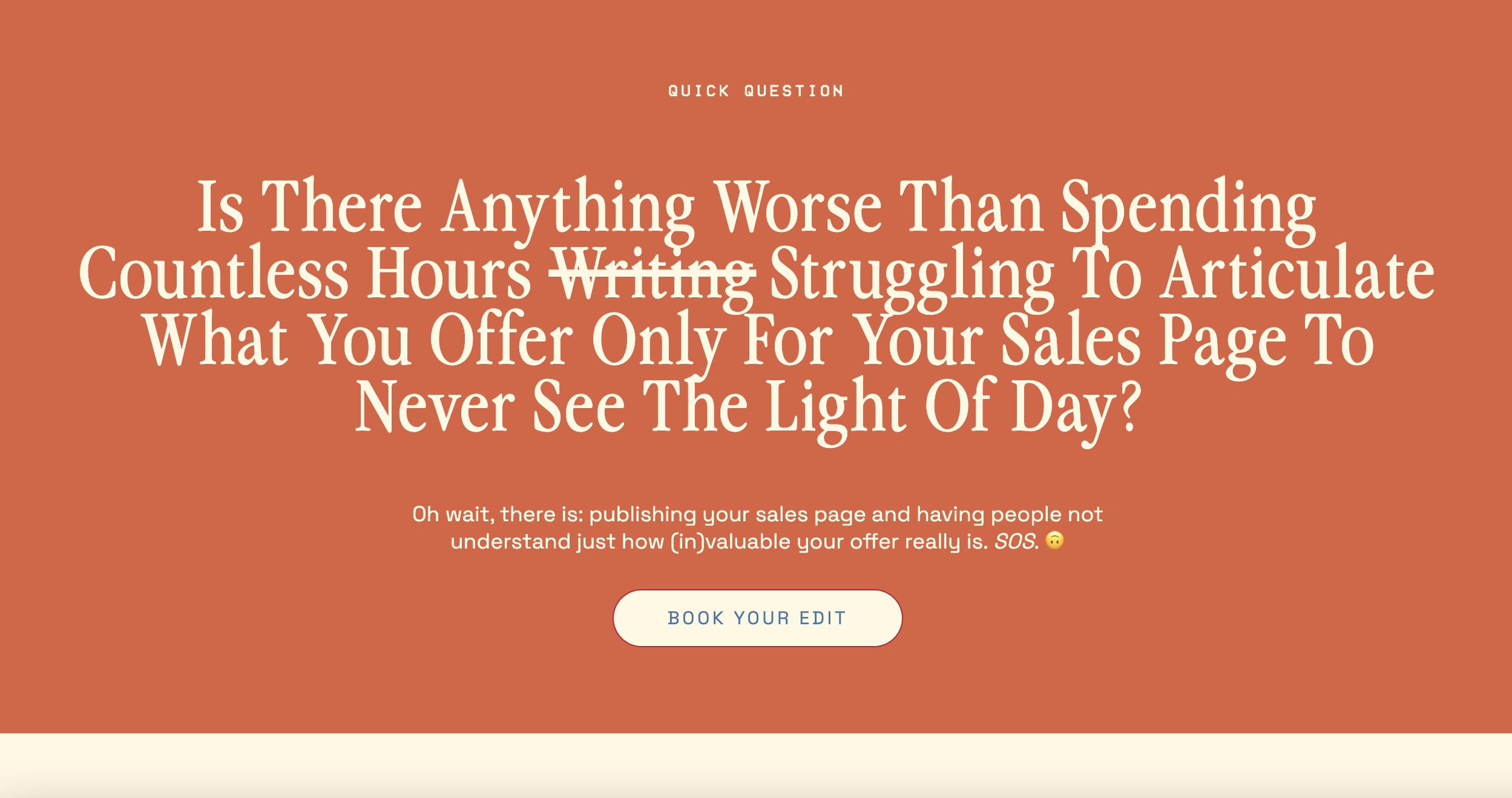
Question Header - Lead with a hard-hitting question that agitates their problem without being forceful.
Why this works: Starting the page with a question breaks containment around what they might expect when they land on the page. It’s also a moment to make them reflect on their current situation.
The Set-Up
If the above-the-fold is designed to keep your people reading your sales page, The Set-Up is where you get them ready to buy your offer.
Sales page writing is storytelling, so if we imagine this overarching narrative as an arc, this section is all about building up to The Big Reveal (a.k.a. introducing your offer). Now, in this arc, there isn’t a fall like there is in fictional stories, but for the purposes of this metaphor, imagine the line on the graph slowly rising. This is a MEATY section because this is where you need to get them to buy into your offer so that by the time they’re introduced to your offer in the next section, you’ve already sold ‘em.
You can write this section in a number of ways and, of course, it’s going to depend on your voice, your audience, your offer (you’re probably sensing a theme that everything is quite dependent on other things when writing copy…) to determine the best way to position your argument. I often trial and error my way through it until I’m satisfied, so if that’s you, you’re doing it right!
The three main goals of this section are to:
reflect to them that they’re in the right place (through self-identifiers)
project the vision you have for their life on the other side of their problem (through future statements)
plot the path to get them from point A to point B (usually in the form of a reframe)
Without the reframe, it's like giving someone who's afraid of flying a plane ticket to Paris without how to help them overcome their flight anxiety; in order for them to hop on that plane (did you just start singing Miley Cyrus, too?) without a second thought, they need to feel capable they can do the thing.
So how might you do this? Explain the POV tied to what led you to creating your offer in the first place so destination B doesn't feel like such a pipedream.
For example, let’s say I’m creating a sales page writing course and I'm talking to a creative person who hates writing sales page copy and they feel bad about themselves because it's so hard for them. They think there’s just something wrong with them and start to believe that they’re bad at writing, they suck at talking about themselves, their offer isn’t good enough, etc.
Of course, none of those things are true but when you’re so deep down the hole of trying to articulate what you do that you convince yourself you don’t even know what you do, the self-doubt starts to win over, ya know?
So here’s where I’d tell them why it's not their fault they feel this way (because it's not) and that they're 100% capable of reaching destination B (because they are).
A couple of questions you may want to ask yourself to really massage out that reframe:
What solutions have they tried in the past you can pat them on the back for?
What do you believe to be true, without a doubt, about their situation that they may not yet?
Going back to my example, I'd want to tell my reader that it's not their fault they believe they're bad at writing; chances are, they were taught to believe that you can either write or you can't. But my goal is to show them that writing is a skill they can learn and build confidence around.
If I can’t get them to buy into the fact that they’re capable of getting over this hurdle (and for you, it could be buying into email marketing or buying into branding), the rest of the sales page doesn’t matter. So take your time with this one.
HOT TIP: Have conversations with your people around what their biggest hesitations and/or beliefs are to understand where they’re coming from so you can address it on your sales page.
The Big Reveal
Ok, we’ve just done the serious leg work! The Set-Up is definitely one of the most challenging sections so once you’ve done that, CONGRATS!
By now, you’ve sold your dream client on your philosophy and they want to know how you’re going to change their life.
Now it’s time to woo them with your offer. Don’t be afraid to put them in big, bold letters here; this is your offer’s moment to shine.
The vibe & tone: celebratory, exciting, delightful, the thing your people have been waiting for.
The Big Reveal is where you reveal to your dream client:
What your offer is (The Name + tag-line)
This is a good opportunity to share what your offer is, who it's for, and why it matters ideally in a sentence or two and in a way that feels equal parts clear and excited.
What makes it so different from other solutions they’ve tried
Questions to ask yourself:
What inspired you to create your solution
What gap does it fill?
How does it work?
3. What your offer’s benefits are (this is different from features, btw)
So many (too! many!) people lead with features when really, regardless of how fancy and important may be, what your people really want is the benefit, the transformation your solution provides. The features are no less important but when you have a long sales page, the benefits should come first.
A quick cheat sheet of the difference between benefits vs features vs deliverables:
Benefits: This is what they've been searching for, tirelessly. This is where you get them excited about what life looks like on the other side of their problem.
Features: The special things you've taken into consideration to make this offer custom to your ideal client. Maybe you're offering body doubling sessions because your ideal client has ADHD and needs accountability support. Or you offer exercise worksheets because you're helping your client practice how to write.
Deliverables: The “tangible” things you deliver to your client. Modules, questionnaires, live group calls.
The Details
If you think we couldn’t get more detailed, THINK AGAIN. This has just been the tip of the iceberg so far! I told you I’m a nerd for sales pages.
So what have you done so far?
You’ve sold your dream client on your philosophy, you’ve introduced your offer, and now you’re going to give them allll the details to help them decide whether this is the right decision for them right now.
This section may include:
What they’ll be able to avoid or no longer sweat after experiencing your offer
A list of the deliverables they get when they invest
A side-by-side “This is for you” vs “This is not for you” to filter out those who may not fit the offer
The total investment
Social proof to back your offer’s transformation
Mini About to introduce people to the person behind the offer (people buy from people)
The Closer
True to its name, The Closer section is where you try to close the sale.
You’ve given your potential client all the info they need to decide whether it’s for them. Chances are they’re pretty sold on your offer but they probably have some questions or doubts that pop up (this is common!).
So I focus on three specific things:
Recap where they are vs where they want to be (and can be if they choose my offer), designed in a neat side-by-side table for clarity
Address objections
Answer questions
I feel like The Closer section is an unsung hero of sales pages and isn’t always utilized to its full potential. Addressing objections is particularly intimidating for most people, fairly so, so they avoid it. BUT addressing objections alone can turn a “no” around.
At the end of the day, when you meet your people where they are with a response that feels genuine and like you have their best interests’ at heart, you won’t sound salesy or icky.
Last but not least, add a Last Call to invite your people to your offer. Skimmers may skip to the very bottom of your sales page, so make sure that your Big Statement is as punchy and clever as your header. This is prime real estate to make a mic drop statement, or a cheeky call to action, or both. The vibe? Hype them tf up for this transformation they're about to experience if when they sign up.
The TL;DR
Writing a conversion-ready sales page can feel super intimidating. But when you look at it like a journey you’re taking your ideal client through and break it down into milestones, so to speak, you ensure they’re ready before they reach each milestone.
If you’re just starting to write a sales page, I highly recommend snagging Your Sales Page Starts Here, my free sales page prep digital folio full of all the questions you need to answer in order to write a juicy sales page that actually works.

If there’s one thing I could tell my younger self, it’s this …
Write now (right now) , edit later.
Even as a copywriter, it took me a long time to really show up and share my voice in the way that I had wanted to. I was always scared of the vulnerability hangover that usually comes after speaking, as a deeply sensitive, (over)thinking human.
And I’ve almost let the self-doubt win a handful of times. Almost.
But I keep coming back to the advice I would give myself when building something I was proud of was still just a dream reserved for my notebooks.
Starting is the first step. And the second. And the third. Because once you start, you usually tend to see that the rest isn’t so bad, and then the next thing you know you have a business that supports the life you’re building and you’re actually having a heck of a lot of fun.
Whoops, I guess I should probably introduce myself, huh? I’m Taylor, a copywriter and brand messaging stylist teaching creative service pros worldwide how to wield brand messaging and copywriting to build the business (and life) they want.
Whether you’re DIYing your copy or you’re ready to collaborate with someone who will 1000% be entirely (too?) invested in your project, I’m so glad you’re here.
